
SysVar#
Note
The code repository is available on GitLab
SysVar is a Python package that streamlines the treatment of systematic uncertainties for collider-physics analyses that rely on Monte-Carlo template fits. It was originally developed within the Belle II context, but its design and interfaces are experiment-agnostic.
In a typical HEP measurement, the observed dataset is a mixture of multiple physical processes. To extract the contribution of any particular process, one builds a statistical model that compares the observed data to the theoretical expectations. When these expectations cannot be expressed with analytical PDFs, non-parametric templates from MC simulation are used instead. This is the standard Monte-Carlo template-fit approach (MC-template fit) [1].
MC prediction, however, is never used raw. Event-by-event correction weights are applied to account for effects such as detector response and calibration, physics reweighting, reconstruction efficiencies etc. These correction weights have systematic uncertainties. They affect both:
the normalisation of a template (total yield)
the shape of a template (bin-to-bin correlations within and across templates)
If fits span multiple channels, multiple templates, multiple observables — keeping book of all correlations becomes non-trivial. Analysts either over-approximate (inflating uncertainties) or lose correlations (biasing the fit). SysVar solves this by providing an end-to-end, consistent machinery to build template histograms and their systematic variations with correlations preserved.
pyhf is now widely used in HEP as the backend for template fits. At present, pyhf allows nuisance parameters to be fully correlated across bins (via histosys modifiers), but it does not provide a native mechanism for encoding partial bin-to-bin correlations arising from systematic variations applied at the event level.
A standard way to recover these correlations is the following:
build the covariance matrix of the systematic variations over the full template space
(all channels × all templates × all bins)diagonalise this covariance matrix
The resulting eigenvectors (“principal components”) capture the correlation patterns in how the template shapes are modified by systematic effects. Each eigenvariation can then be implemented as a fully correlated nuisance parameter in pyhf.
SysVar provides tools to:
apply data/MC correction weights to a dataframe
construct systematic variations of those correction weights
histogram MC events into nominal and varied templates
construct and diagonalise the full covariance matrix in the space (channels × templates × bins)
produce orthogonal eigenvariations (“eigendirections”) for use in downstream fits
determine how many eigenvariations are actually needed to faithfully represent the full systematic space (compression / truncation)
Why this matters:
preserves correlations exactly
reduces the manual bookkeeping burden
enables natural scaling to large analyses (many channels, many templates)
enables combining different analyses within a unified workflow
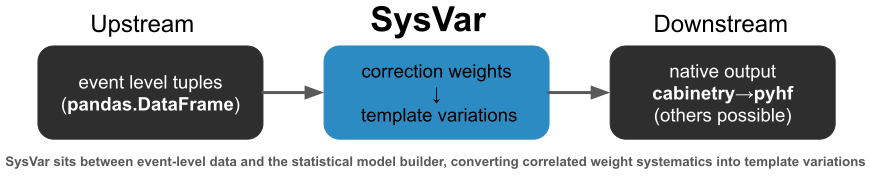
SysVar is intended as a drop-in tooling layer between downstream and upstream tasks as described in the graphic below:
The following pages walk you through using SysVar step-by-step.